How Family-Owned Businesses Honor Legacy and Position for the Future

- Build a resilient capital strategy to support the business over generations
- Create intentional and formal succession plans—early
- Establish ownership structures through formal governance
- Align multigenerational family wealth with values, governance, and long-term legacy
Family-owned businesses are pillars of the global economy, shaping industries and communities through their impact and innovation. Companies with at least 20% family-owned capital share or voting rights contribute to 70% of global GDP1 and account for approximately 60% of employment2.
Today, as family enterprises enter new markets, adopt emerging technologies, and prepare the next generation of leaders, they are also navigating an AI-innovation supercycle and rapidly evolving capital markets.
Meeting this moment requires thoughtful planning and strategic decision-making. Beyond macroeconomic factors, families can face five foundational questions with lasting implications:
- Who gets to manage?
- Who has the right to employment?
- Who gets capital?
- Who gets ownership?
- Who gets control?
For family-owned businesses, answering these questions is not a one-time exercise. It can be an ongoing process that evolves alongside the business, the family, and the markets around them. Families can preserve their legacy and help position their business for future growth in this rapidly evolving landscape with a resilient capital strategy, intentional succession planning, formalized ownership and governance structures, and aligning multigenerational family wealth with values, governance, and long-term legacy.
1. Build a sustainable capital strategy
As your family enterprise grows, the focus may shift from simply securing liquidity to creating a resilient capital structure that can support the business over generations.
There are numerous ways for businesses to access capital. You may consider different approaches to strategic leverage, from traditional commercial banks to private pools of capital. A key consideration will be how to optimize capital structures and equity returns for the founding investors without putting the business at risk.
External equity capital, such as private equity funds, can also support scaling and expansion. While nonbank alternatives can offer flexibility, this type of capital requires careful evaluation of its impact on ownership and governance. A formal and thoughtfully crafted governance structure can help families manage external investors and align their contributions with long-term family priorities.
2. Create intentional and formal succession plans—early
There is no one-size-fits-all model for passing down a family business. Some families choose to keep an enterprise solely in the family, while others successfully integrate outside CEOs and leadership.
What’s more important for families: Choosing leaders early, intentionally, and with formal plans in place. A recent PWC study of US family businesses found that over half maintain informal succession plans, yet only one-third have formalized them3.
Building a clear, formal plan provides a road map for leadership transition and can help surface potential pressures before they escalate. As families think about succession plans, it can be helpful to keep these four considerations in mind:
- Family involvement: Is it encouraged or optional, and what are the criteria to get involved?
- Leadership philosophy: How will the business balance meritocracy and the continued involvement of family members?
- Balancing expertise and oversight: How and when will the family leverage external executives?
- Managing potential conflicts: How will the family identify potential sources of disagreement and manage them with appropriate governance frameworks?

3. Establish ownership structures through formal governance
One of the most sensitive decisions family enterprises face is how to divide shares or assets among successors.
As the business grows, the number of stakeholders increases, and leadership changes, it is important for families to actively decide whether to limit the number of decision-making shareholders as well as how control will be exercised and passed on.
Establishing a structured governance process using bylaws, articles of incorporation, or shareholder agreements can help protect both the family and business, and facilitate decision-making.
Families can consider including:
- Transfer of ownership rules
- Exercise of control rules
- Exit rights
- Conflict resolutions mechanisms
- Involvement of third parties
- Trust and holding companies
4. Align multigenerational family wealth with values, governance, and long-term legacy
In modern, multigenerational family enterprises, managing wealth is more than an exercise in asset allocation—it is a holistic endeavor that aligns financial capital with family values, governance, and long-term legacy. True stewardship requires defining a comprehensive wealth mandate, formalizing capital distribution philosophies, establishing clear boundaries for family involvement, and selecting an operational model that matches the family’s unique scale and complexity. When families align on these foundational priorities, multigenerational enterprises can transform their wealth from a complex administrative challenge into a powerful, enduring engine for legacy and impact.
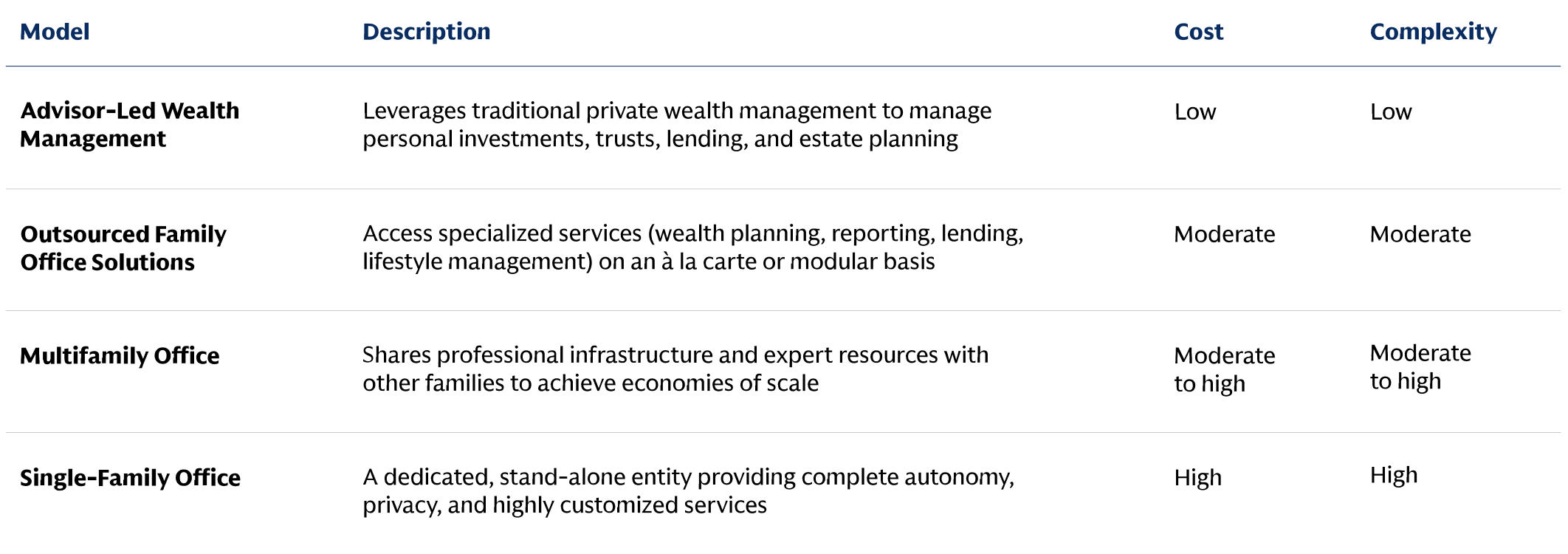
As families navigate generational transitions and liquidity events, they can choose from a spectrum of models that balance operational control, complexity, and cost. To minimize administrative overhead, families typically evaluate these options based on their specific scale and governance needs.
Below are four models families can consider:
Conclusion
The leader of every founder-led or family business carries a dual mandate: Steward the enterprise while stewarding personal and family legacy. By implementing robust capital strategies, intentional succession plans, formalized ownership structures, and aligning multigenerational family wealth with values, governance, and long-term legacy, families can help ensure their businesses not only survive but thrive in an ever-changing economic and technological landscape.
For more information and insights, read our full report developed in collaboration with our colleagues from Investment Banking, Honoring Legacy and Positioning for the Future: A Modern Playbook for Family-Owned Businesses, or speak with your Goldman Sachs team.
1. Laurent Capolaghi and Aude de Roquancourt, “Family-Owned Businesses: The Role of Private Equity in Succession Planning,” EY, January 20, 2025, https://www.ey.com/en_lu/insights/private-equity/family-owned-businesses-the-role-of-private-equity-insuccession-planning.
2. United Nations Conference on Trade and Development, “Empowering Family Businesses to Fast-Track Sustainable Development,” April 13, 2021, https://unctad.org/news/empowering-family-businesses-fast-track-sustainable-development.
3. PwC, Continuity and Succession Planning: Family Enterprises, 2024, https://www.pwc.com/us/en/private-company-services/publications/assets/pwc-family-business-continuity-succession-planning.pdf.
This material is intended for educational purposes only and is provided solely on the basis that it will not constitute investment advice and will not form a primary basis for any personal or plan’s investment decisions. While it is based on information believed to be reliable, no warranty is given as to its accuracy or completenessand it should not be relied upon as such. Goldman Sachs is not a fiduciary with respect to any person or plan by reason of providing the material herein, information and opinions expressed by individuals other than Goldman Sachs employees do not necessarily reflect the view of Goldman Sachs. This material may not, without Goldman Sachs’ prior written consent, be (i) copied, photocopied or duplicated in any form, by any means, or (ii) distributed to any person that is not an employee, officer, director, or authorized agent of the recipient. This material is not an offer or solicitation with respect to the purchase or sale of any security in any jurisdiction. Investing involves risk, including the potential loss of money invested. Past performance does not guarantee future results. Neither asset diversification or investment in a continuous or periodic investment plan guarantees a profit or protects against a loss. Information and opinions provided herein are as of the date of this material only and are subject to change without notice.
© 2026 Goldman Sachs. All rights reserved.
Goldman Sachs & Co. LLC is registered with the Securities and Exchange Commission (“SEC”) as both a broker-dealer and an investment adviser and is a member of the Financial Industry Regulatory Authority (“FINRA”) and the Securities Investor Protection Corporation (“SIPC”).